
Key takeaways
- Safety first. Stay away from downed power lines and unstable trees.
- Secure pets and kids right away, since a damaged fence may not contain them.
- Photograph the damage before cleanup, and check your homeowner's insurance policy.
- Many storm-damaged fences can be repaired section by section rather than fully replaced.
Charlotte gets its share of rough weather. Summer thunderstorms roll through with sudden wind gusts, the remnants of tropical systems bring days of soaking rain and strong winds, and every few years an ice storm coats limbs until they snap. Fences take a lot of that punishment, especially in neighborhoods with mature trees.
If you have walked outside after a storm to find a fallen limb across your fence, a section leaning or panels blown flat, this guide walks you through what to do next.
Step 1: Stay safe
Before you look at the fence, look at the surroundings:
- Downed power lines: stay far away from any downed lines, including ones touching your fence. Metal fences and wet wood can conduct electricity. Call your power company and, if there is immediate danger, 911.
- Unstable trees and hanging limbs: broken limbs can fall without warning. Keep clear and call a tree professional for large or hanging limbs.
- Sharp debris: broken boards, exposed nails and twisted metal can cause injuries. Wear gloves and sturdy shoes.
- Leaning sections: a damaged fence section can fall. Do not lean on it or let kids play near it.
Step 2: Secure pets and kids
A damaged fence may not keep your dog in. Even a small gap can be enough for an escape, and storm noise can make dogs anxious and more likely to bolt. Until the fence is repaired:
- Take dogs out on a leash.
- Supervise kids in the yard.
- Block gaps temporarily if you can do so safely.
- Check gates, which may have been knocked out of alignment and no longer latch.
If you have a pool, a damaged pool barrier is a safety issue. Keep children away from the pool area until the barrier is secure again.
Step 3: Document the damage
Before you start cleaning up, take photos and video:
- Wide shots showing the whole fence line and the cause of damage, like a fallen tree
- Close-ups of broken boards, panels, posts and gates
- The date and time
- Any damage to other property, like sheds or vehicles
Store the photos somewhere safe, like a cloud folder, along with notes about when the storm happened. Good documentation helps if you file an insurance claim and helps a fence contractor understand the damage.
Step 4: Check your insurance
Many homeowner's insurance policies include coverage for fences and other structures, but coverage, deductibles and exclusions vary. Review your policy or call your insurance agent to understand what is covered. Ask about:
- Whether fences are covered under other structures
- Your deductible
- Whether tree removal is covered
- What documentation they need
- Whether they need to inspect before repairs
If a neighbor's tree fell on your fence, or your tree fell on theirs, coverage questions can be more complicated. Talk with your insurance agent. We are fence installers, not insurance experts, but we can provide a written estimate for the repair or replacement work for your records.
Step 5: Clear the debris safely
Once it is safe and documented, clear what you can:
- Small branches and loose boards can usually be cleared by homeowners.
- Large limbs and fallen trees should be handled by a tree service.
- Do not try to pull a heavy limb off a fence by yourself. It can shift and cause injury or more damage.
Leave the actual fence repair to a professional unless the fix is very minor.
Step 6: Assess repair vs. replacement
Not every storm-damaged fence needs to be replaced. Many can be repaired section by section.
Usually a repair
- A few broken boards or pickets
- One or two damaged sections from a fallen limb
- A single leaning post
- A gate knocked out of alignment
- Damaged vinyl or aluminum panels that can be replaced
May point to replacement
- Long stretches flattened by wind
- Many posts loosened or broken
- An older fence that was already worn, rotting or leaning before the storm
- Damage that would leave a patchwork of old and new materials
If the fence was already near the end of its life, a storm may be a good time to replace it with something that better fits how you use your yard. See our repair or replace guide.
Repairs by material
Wood
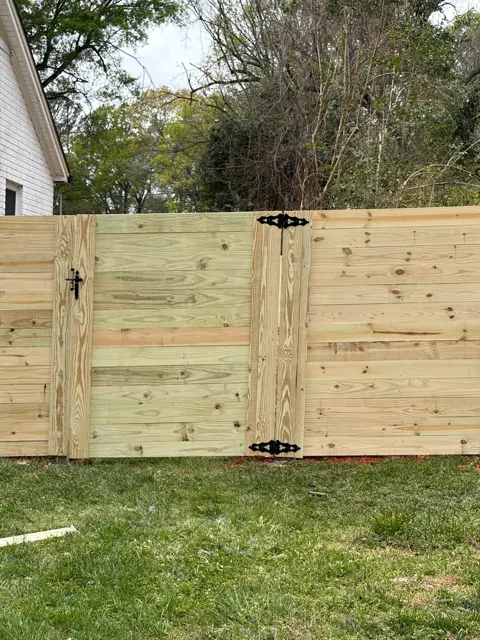
Broken boards, rails and posts can usually be replaced. New wood will look different from weathered boards at first, but staining can help blend it in over time. See when to stain a new wood fence.
Vinyl
Damaged vinyl panels, pickets and posts can often be replaced individually. Matching color and style can be easier when the original product is still available.
Aluminum
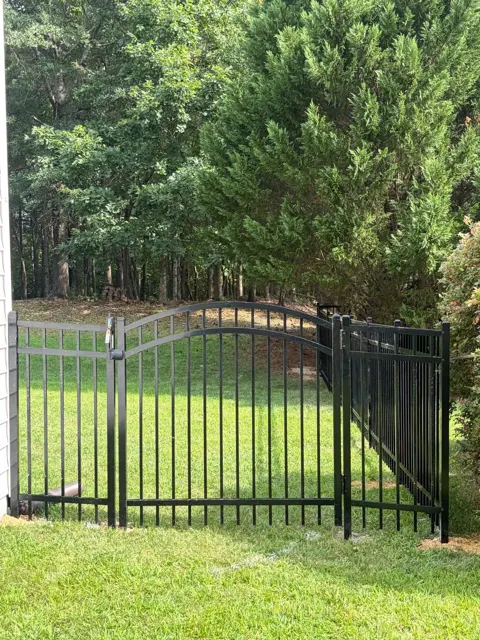
Bent aluminum panels typically need to be replaced. Posts and gates can be realigned or replaced as needed.
Chain link
Bent top rails, damaged fabric and leaning posts can usually be repaired by replacing the affected parts and re-tensioning the fabric.
Temporary fixes
While you wait for repairs, a few temporary steps can help:
- Prop a leaning section with a brace if it is safe to do so.
- Close small gaps with temporary barriers to keep pets in.
- Secure a loose gate so it does not swing in the wind.
- Keep pets on leashes regardless.
Temporary fixes should never put you at risk. When in doubt, leave it for the professionals.
Watch out for storm chasers
After major storms, out-of-town contractors sometimes go door to door offering quick repairs. Some are legitimate, but others take deposits and disappear or do poor work. Protect yourself:
- Verify that the contractor is licensed and insured.
- Ask who will do the work: the company's own employees or subcontractors.
- Get a written estimate.
- Check reviews and local references.
- Be wary of high-pressure tactics and large upfront payments.
See our guide to choosing a fence contractor.
Preventing future storm damage
- Trim trees: have dead and overhanging limbs removed by a tree professional.
- Solid posts: posts set at the proper depth in concrete resist wind much better. See our red clay post guide.
- Consider wind exposure: solid privacy fences catch more wind than open styles. On exposed lots, shadowbox or semi-privacy styles let some wind pass through.
- Maintain the fence: rot and loose hardware make a fence more vulnerable.
- Close gates before storms so they do not swing and slam.
- Secure outdoor items that could blow into the fence.
Our guide to fences around trees covers planning fence lines near trees.
Upgrading after a storm
If a storm takes out a large part of an aging fence, it can be an opportunity to rethink the design. Maybe you have wanted more privacy, a wider gate for a trailer, a puppy-friendly bottom or a lower-maintenance material. Replacing with an upgrade rather than a like-for-like rebuild lets you fix what never quite worked. Ron can price both options so you can compare. Browse styles in the Fence Design Studio to see what is possible.
Neighbor trees and shared fences
If a neighbor's tree damaged your fence, or your tree damaged theirs, talk with each other and with your insurance agents. If the fence is on a shared line, coordinate repairs together. Our property line guide covers shared fence considerations.
HOA considerations
If you are replacing rather than repairing, you may need HOA approval, especially if you are changing material, style, color or height. Repairs that match the existing fence often do not need new approval, but check your covenants. See our HOA approval checklist.
What a storm can reveal about your fence
Storms are a stress test. If one section went down while the rest stood firm, the cause is usually obvious: a falling limb or a single weak post. But if long runs leaned or posts snapped at ground level, it may reveal wider issues like rotted posts, shallow footings or an aging fence that was close to the end of its life. A careful assessment after a storm helps you decide whether a targeted repair is enough or whether it is time to plan a replacement that will hold up better in the next storm.
What to expect from a repair visit
When you call about storm damage, Ron will ask about the material, the extent of the damage and whether anything is still hazardous. During the visit, he will walk the fence line, check the posts on either side of the damaged area, look at gates and point out any pre-existing issues the storm exposed. You will get a clear explanation of what can be repaired, what may need replacement and a written estimate. Repairs are scheduled with our in-house crew, who remove damaged materials, reset or replace posts where needed and rebuild the affected sections to match as closely as possible.
Matching old and new materials
One common concern after a repair is how the new sections will look next to the old. Wood is the trickiest because new boards are lighter than weathered ones. Over time, new wood weathers toward the color of the old, and staining the whole fence after repairs can bring everything together. Vinyl and aluminum are easier to match when the original style is still available, though very old vinyl may have faded slightly. Ron will tell you upfront if an exact match is not possible and suggest options, like replacing a full run so it looks consistent.
Charlotte storm season at a glance
- Spring: strong thunderstorms with gusty winds and occasional hail.
- Summer: frequent afternoon thunderstorms with sudden downbursts.
- Late summer and fall: remnants of tropical systems bring heavy rain and wind.
- Winter: occasional ice storms that weigh down and snap limbs.
Walking your fence line after each major storm helps you catch small problems before they grow.
Post-storm fence checklist
- Check for downed power lines and hazards.
- Secure pets and kids.
- Photograph and video the damage.
- Review your insurance policy.
- Arrange tree removal if needed.
- Clear small debris safely.
- Get a written repair or replacement estimate.
- Check HOA requirements if replacing.
Get your fence back in shape
Ron can assess your storm-damaged fence, explain whether a repair or replacement makes sense and give you a written estimate. Our in-house crew handles the work, with no subcontractors, and we are licensed and insured. New installations are backed by our 2-year workmanship warranty. We serve Mecklenburg, Union and Cabarrus counties and Fort Mill, Rock Hill and Tega Cay, SC, Monday through Saturday, 7 AM to 7 PM. Call Ron at (980) 339-2182 or request an estimate online.
Frequently asked questions
What should I do first after a storm damages my fence?
Check for safety hazards like downed power lines and hanging limbs, secure pets and kids, then photograph the damage before cleanup.
Does homeowner's insurance cover fence damage?
Many policies include coverage for fences under other structures, but coverage and deductibles vary. Review your policy or call your agent.
Can a storm-damaged fence be repaired instead of replaced?
Often, yes. Broken boards, damaged panels, single posts and gates can usually be repaired. Long stretches of damage or an already aging fence may point to replacement.
Can you provide an estimate for my insurance claim?
We can provide a written estimate for the repair or replacement work for your records. Coverage decisions are up to your insurance company.
How can I prevent storm damage to my fence?
Trim dead and overhanging limbs, make sure posts are set solidly, maintain the fence and close gates before storms.
Will new boards match my old fence?
New wood starts lighter than weathered boards but blends over time, and staining the whole fence after repairs helps. Vinyl and aluminum match more easily when the original style is still available.
Should I wait for my insurance adjuster before repairs?
Check with your insurance company. Some want to inspect before repairs. Take photos and keep damaged materials until you know.

About the author
Fences & Firepits team, reviewed by Ron Memallaj, owner of Fences & Firepits LLC. We're a licensed and insured fence company in Charlotte, NC, serving the city and surrounding communities since 2022. Every fence we build is installed by our own in-house crew. We don't hire subcontractors.