
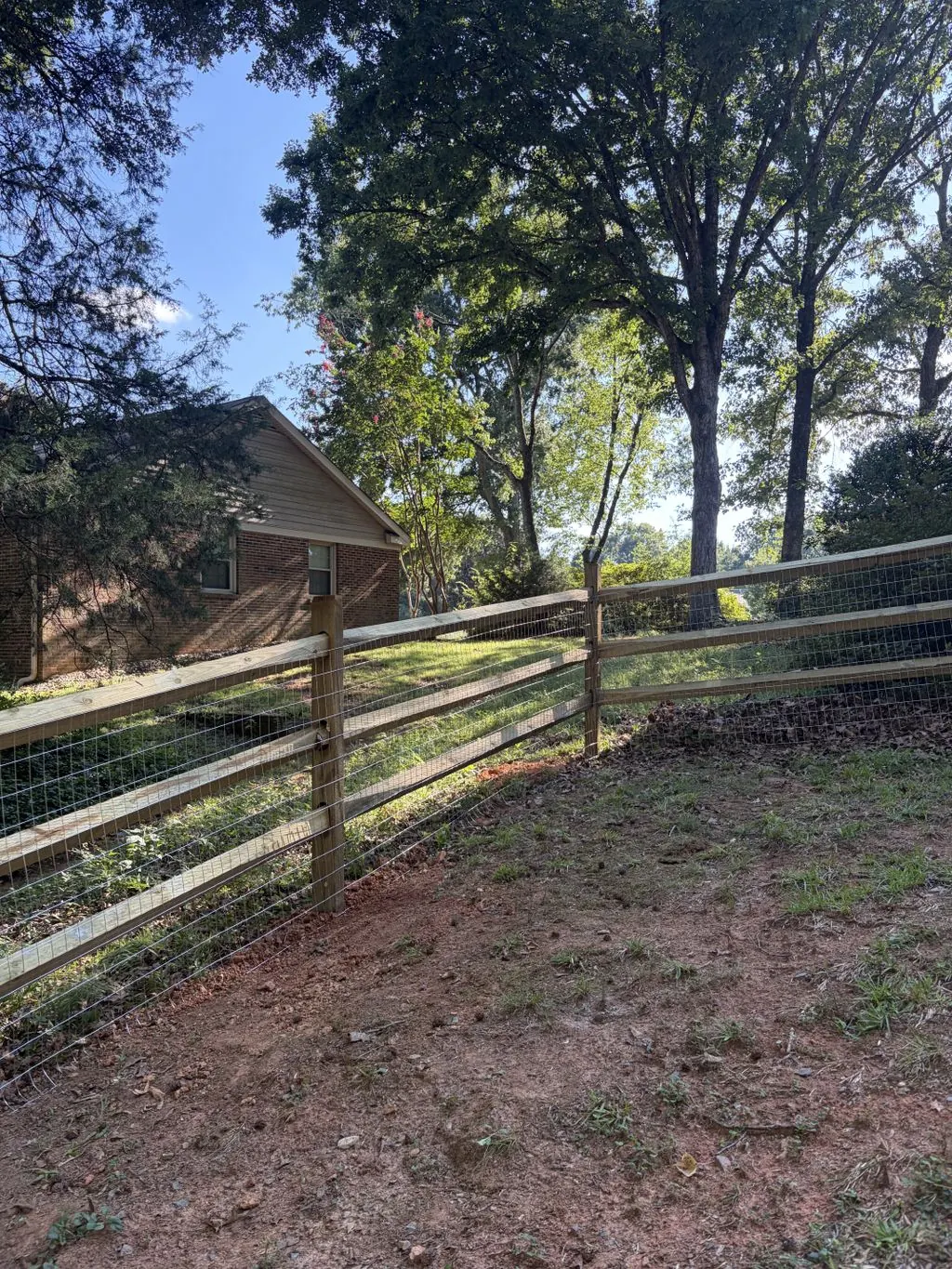
Key takeaways
- Split rail defines a property with an open, rustic look that suits larger lots and natural landscapes.
- Two-rail and three-rail layouts are common. Three-rail is taller and more defined.
- On its own, split rail will not contain most dogs. Adding wire mesh makes it pet friendly.
- Split rail is one of the most cost-effective ways to fence a large area.
Drive through the larger lots of Waxhaw, Weddington, Marvin, Mint Hill or Mount Pleasant and you will see split rail fences everywhere: lining driveways, framing front lawns, tracing the edges of pastures and wooded backyards. Split rail has a timeless, rustic character that feels right at home in the Carolina countryside and in suburban neighborhoods that want a softer, more natural look.
It is also one of the most misunderstood fence styles. People sometimes choose it for the look and then discover it does not keep their dog in. This guide covers what split rail is, where it works best, how to make it pet friendly and what to expect over time.
What is a split rail fence?
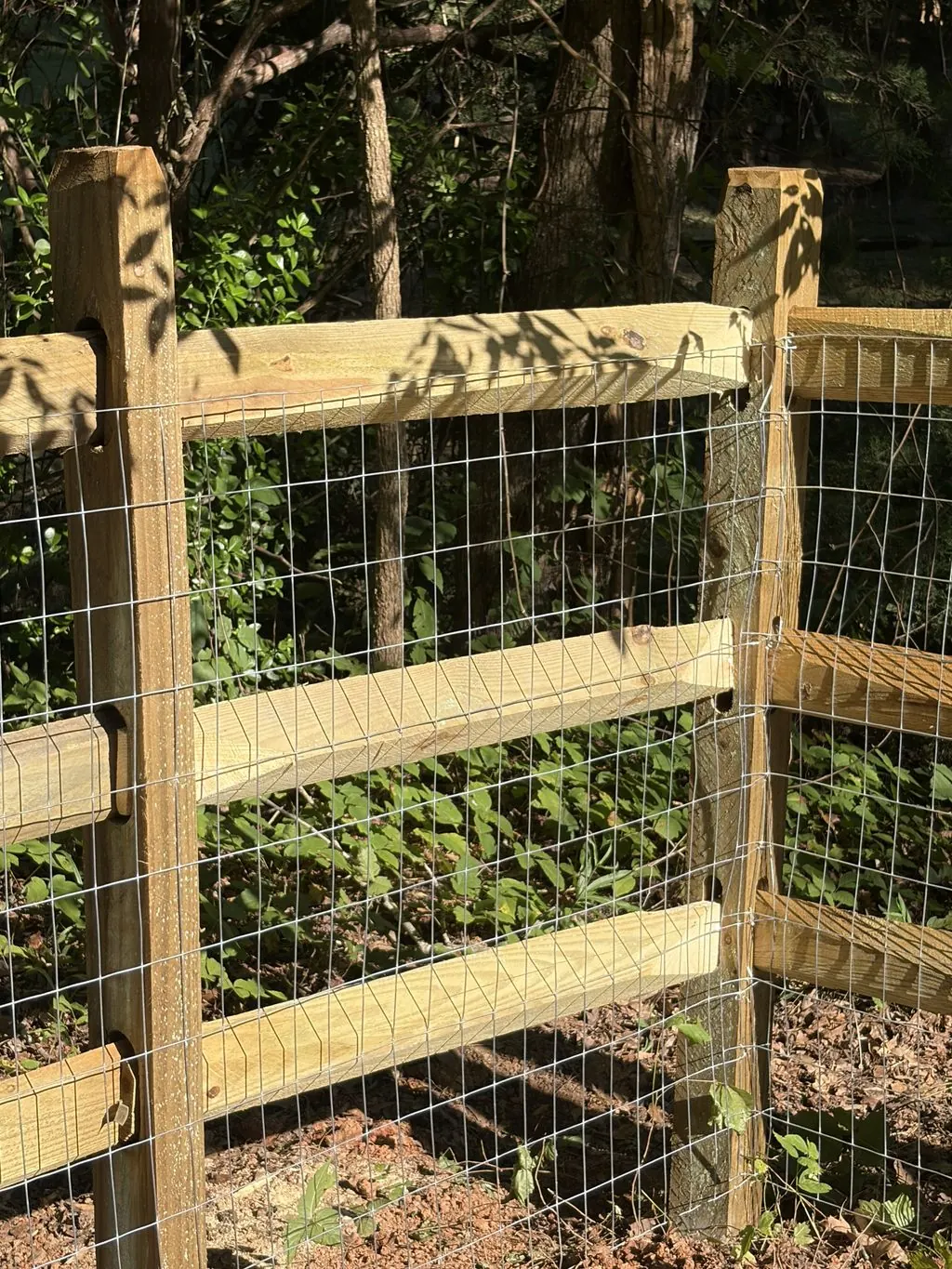
A split rail fence uses wooden posts with horizontal rails that fit into openings, called mortises, cut through the posts. Traditionally, the rails were split from logs along the grain, which gives them a rough, natural texture. There are no pickets or boards, so the fence is mostly open space.
Because the rails slide into the posts rather than being nailed on, split rail can often follow gentle slopes and is relatively simple to repair: a damaged rail can be swapped out.
Two-rail vs. three-rail
Two-rail
- Lower profile, typically used for decorative borders and marking boundaries
- Very open and minimal
- Lower cost per foot
Three-rail
- Taller and more defined
- Better at discouraging people from cutting across the yard
- Better base for adding wire mesh for pets
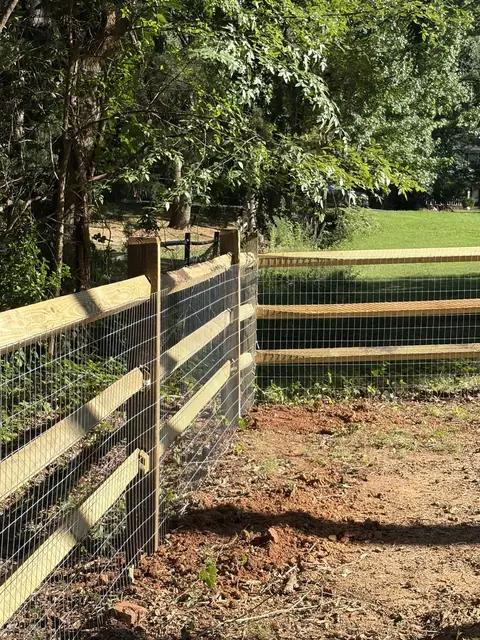
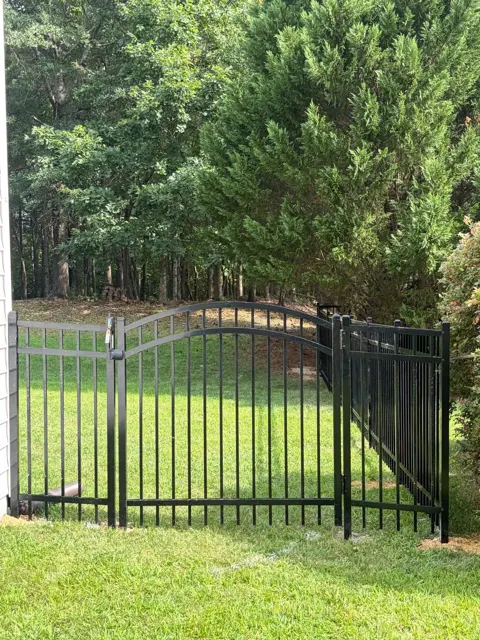
Our three-rail split rail fence with wire and arched gates in Ballantyne shows how a three-rail layout with mesh can define a yard and contain pets while keeping a natural look.
Where split rail works best
- Large lots: split rail is one of the most cost-effective ways to define a big property.
- Front yards: it adds curb appeal without blocking views. See front yard fence ideas.
- Along driveways: lines the drive and guides visitors.
- Wooded edges: blends naturally with trees. See our guide to fencing around trees.
- Gardens and landscaping: frames beds and keeps foot traffic out.
- Pastures and rural properties: a traditional choice for open land.
- HOA neighborhoods that favor open fences: some communities prefer split rail to preserve open views. Always check your covenants.
Where split rail is not the best fit
- Privacy: split rail is completely open. See our privacy fence guide instead.
- Small dogs without mesh: they walk right through.
- Pools: split rail does not meet typical pool barrier requirements. See pool fence requirements.
- High security: it is a boundary marker, not a barrier.
- Small urban yards: the rustic look can feel out of place on very small lots.
Making split rail pet friendly
The most common upgrade to split rail is adding wire mesh to the inside of the fence. Welded wire mesh attached to the posts and rails closes the gaps so dogs cannot slip through, while the fence still looks open and rustic from a distance.
Tips for pet owners
- Choose three-rail for a taller, sturdier base for mesh.
- Mount mesh on the inside so the rustic rails face out.
- Keep the bottom tight to the ground for diggers and small dogs.
- Consider height: athletic jumpers may clear a split rail fence. For high jumpers, a taller fence type may be better. See our large dog guide.
- Plan gates carefully: gates should have mesh too, with secure latches.
For tiny dogs and puppies, see our small dog and puppy guide.
Split rail vs. other open fences
| Fence | Look | Pet containment | Maintenance |
|---|---|---|---|
| Split rail | Rustic, natural | With mesh | Occasional rail replacement |
| Vinyl ranch rail | Clean, crisp | With mesh | Wash occasionally |
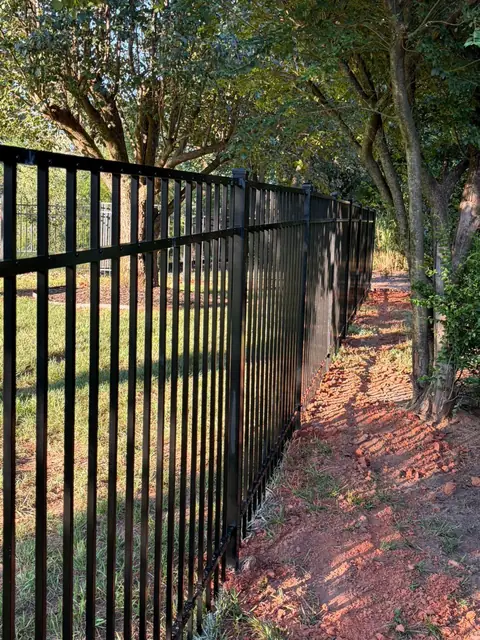
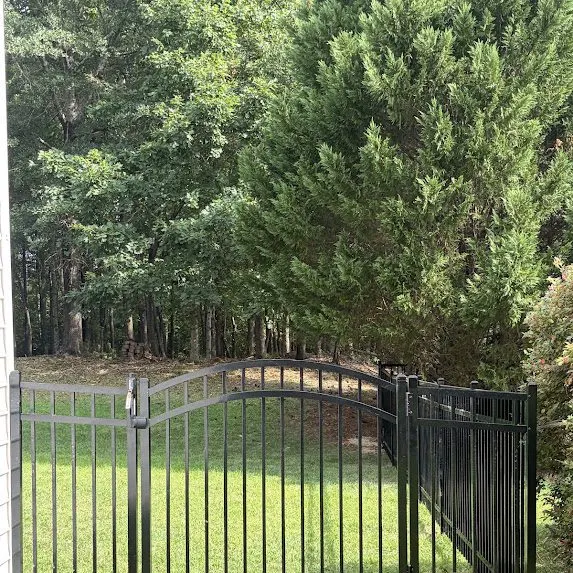
| Aluminum | Elegant, ornamental | Yes, puppy picket for small dogs | Rinse occasionally |
| Black chain link | Practical, blends in | Yes | Very low |
See our vinyl styles guide for ranch rail and our aluminum styles guide.
Gates for split rail
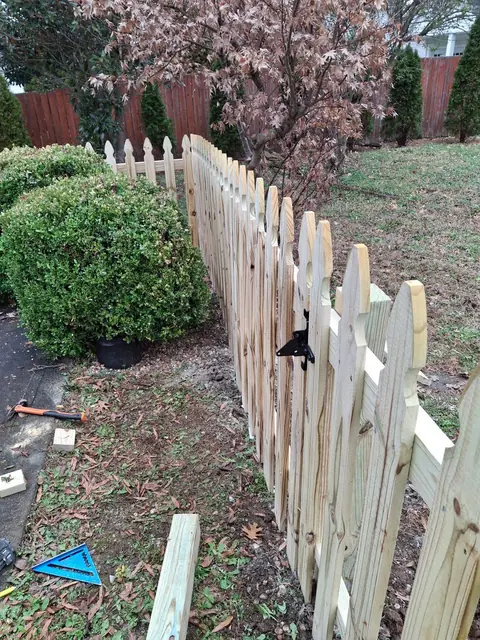
Split rail fences pair beautifully with rustic wood gates, including arched designs that create a welcoming entry. Walk gates, double gates and wide driveway gates are all possible. If the fence has mesh for pets, the gate should too. We offer gravity latches, lockable latches and self-closing latches. See our custom gates page and driveway gate guide.
Installation considerations
- Post spacing: fixed by rail length, so posts are evenly spaced along the line.
- Slopes: rails can often follow gentle slopes naturally. Steeper grades may need stepped sections.
- Roots and rocks: because posts are spaced farther apart than many fence types, it is often easier to avoid obstacles.
- Soil: posts are set firmly for Charlotte's clay. See our red clay post guide.
- Utilities: public utilities are located before digging.
Caring for split rail
- Walk the fence a couple of times a year to check for loose or cracked rails.
- Replace damaged rails as needed. Because they slide into the posts, replacement is usually straightforward.
- Keep soil and mulch away from the base of posts.
- Check wire mesh for loose fasteners or damage.
- Clear vines and brush from the fence line.
Many homeowners leave split rail unstained to weather naturally to a soft gray, which suits its rustic character. Others prefer to stain it for a warmer, more uniform color. See our maintenance guide.
Cost considerations
Split rail is one of the most cost-effective ways to fence a large area because it uses less material per foot than privacy, picket or ornamental styles. Adding wire mesh increases the cost but is still often less than other pet-friendly options over long runs. Gates, slopes and site conditions also affect price. See starting rates on the pricing page and get a preliminary range in the cost calculator.
HOA considerations
Some HOAs, especially in communities with larger lots or a rural character, favor split rail because it preserves open views. Others restrict it or specify the number of rails, the color or whether mesh is allowed. Check your covenants and include details in your architectural request. We help prepare paperwork, but approval is always up to your HOA. See our HOA approval checklist.
Design ideas
- Driveway entry: split rail lining both sides of the driveway with an arched gate at the entrance.
- Front lawn frame: a two-rail fence across the front with flower beds along it.
- Garden enclosure: three-rail with mesh to keep pets out of vegetable beds.
- Wooded backyard: three-rail with mesh tracing the edge of the trees for a dog area that blends into the woods.
- Mixed fencing: split rail across the front and sides, with a privacy section near the patio.
Landscaping with split rail
Split rail is a natural partner for plants. Climbing roses, clematis and native vines can weave along the rails for a cottage look, though vines add weight and moisture, so keep them trimmed. Ornamental grasses, black-eyed Susans, coneflowers and other native perennials along a split rail fence create a relaxed, meadow-like border that suits the Carolina landscape and supports pollinators. Mulched beds along the base reduce trimming, as long as mulch is kept away from the posts themselves.
Split rail on sloped and uneven land
Many larger lots around Charlotte roll gently, and split rail handles that well. Because rails slide into mortised posts, the fence can follow modest grade changes smoothly, keeping a natural line across the land. On steeper grades, sections may be stepped. Ron walks the property and explains how each section will follow the ground during the estimate. See our sloped yard guide.
Common split rail mistakes
- Expecting it to contain a dog without mesh. It will not.
- Choosing two-rail when you need definition. Three-rail is taller and better for mesh.
- Using split rail around a pool. It does not meet typical pool barrier requirements.
- Letting vines take over. Heavy vines can loosen rails over time.
- Piling mulch against posts. It holds moisture at the most vulnerable spot.
A short history of split rail
Split rail fencing goes back centuries in America. Early settlers split logs along the grain with wedges and mauls because it was faster than sawing and used materials cleared from the land. Zigzag "worm" fences, which needed no posts at all, were common on early farms across the Carolinas. Over time, post-and-rail designs with mortised posts became the standard because they use less wood and take up less ground. Today's split rail fences carry that heritage, which is part of why they feel so at home on Piedmont farmland and in neighborhoods built on former farms around Charlotte.
Questions to ask before choosing split rail
- Do I need to contain a pet, and if so, how large and how athletic?
- Is privacy important anywhere on the property?
- Is there a pool that needs a compliant barrier?
- Does my HOA allow split rail, and does it allow mesh?
- How many gates do I need, and where?
- How long is the run, and how does split rail compare in cost to other options over that distance?
Ron answers all of these during your free estimate, and he can price split rail alongside alternatives so you can compare.
Combining split rail with other fence types
Split rail does not have to stand alone. On many larger properties, homeowners use split rail along the front and far boundaries, where open views and a rustic look matter most, and switch to a privacy fence around the patio or pool area, where privacy and safety rules apply. Others run split rail with mesh around a large dog area and keep the rest of the property open. Mixing styles lets you put the right fence in each place while keeping costs manageable across long distances.
Is split rail right for you?
Split rail rewards homeowners who value open space and a natural setting. It frames the land rather than closing it in, it lets wildlife and breezes pass and it ages gracefully into the landscape. Choose split rail if you want an open, natural look, have a larger property or want to define a boundary affordably. Add mesh if you have pets. Choose something else if you need privacy, a pool barrier or high security.
Ron can help you decide during a free on-site estimate. Fences & Firepits is licensed and insured, every installer is on our own payroll with no subcontractors, and our work is backed by a 2-year workmanship warranty. Learn more about split rail fencing, try designs in the Fence Design Studio or call Ron at (980) 339-2182.
Frequently asked questions
Will a split rail fence keep my dog in?
Not on its own. Adding welded wire mesh to the inside of the fence closes the gaps and makes split rail pet friendly.
Should I choose two-rail or three-rail?
Two-rail works for decorative borders. Three-rail is taller, more defined and a better base for wire mesh.
Does a split rail fence need to be stained?
Many homeowners let split rail weather naturally to a soft gray, which suits its rustic look. Keep soil and mulch away from posts to help them last.
Is split rail good for a pool?
No. Split rail does not meet typical pool barrier requirements. Aluminum is a more common pool fence choice.
Is split rail cheaper than other fences?
It is one of the most cost-effective ways to fence a large area because it uses less material per foot. Mesh, gates and site conditions affect the total.
Can split rail follow a slope?
Yes. Because the rails slide into mortised posts, split rail can follow gentle grade changes smoothly. Steeper sections may be stepped.
What gate works with split rail?
Rustic wood gates, including arched designs, pair naturally with split rail. If the fence has wire mesh for pets, the gate should have mesh too, with a secure latch.

About the author
Fences & Firepits team, reviewed by Ron Memallaj, owner of Fences & Firepits LLC. We're a licensed and insured fence company in Charlotte, NC, serving the city and surrounding communities since 2022. Every fence we build is installed by our own in-house crew. We don't hire subcontractors.